Login
REGISTER
Call us:
+44 203637 7139
e-mail:
info@adhdplus.co.uk
Attention deficit hyperactivity disorder (ADHD) is a diagnosis given to people who have challenges with:
Most people experience these challenges at some point in their lives, or in certain situations. For example, someone might struggle to concentrate the following day if they’ve had a bad night’s sleep.
However, for people with ADHD, these challenges usually begin in childhood and for most people they continue as they grow up, though they may change or improve. These challenges will also affect someone in many areas of their life.
“For me, reading a book can feel like a carousel ride with the book held by someone in the crowd. Tasks can feel like a car journey where my impatient self is in control of the pedals, but my curious self is holding the wheel.” – A person with ADHD
ADHD is a ‘neurodevelopmental disorder’. These are disorders that can affect lots of different brain functions, including learning, communication, movement, emotions and attention.
Neurodevelopmental disorders start in childhood and for many people are life-long. This means that they can’t be ‘cured’. Instead, people with neurodevelopmental disorders can benefit from support and changes to their environment.
People who have one neurodevelopmental disorder are more likely to have another one, such as:
If someone has ADHD that isn’t recognised or treated properly, this can negatively affect their mental and physical wellbeing.
People with ADHD are frequently diagnosed with other mental and physical health conditions. This can make it difficult to recognise underlying ADHD.
ADHD affects about 3 to 4 in every 100 adults. People with ADHD can be of any background, but ADHD is more common in people who have:
Or who were:
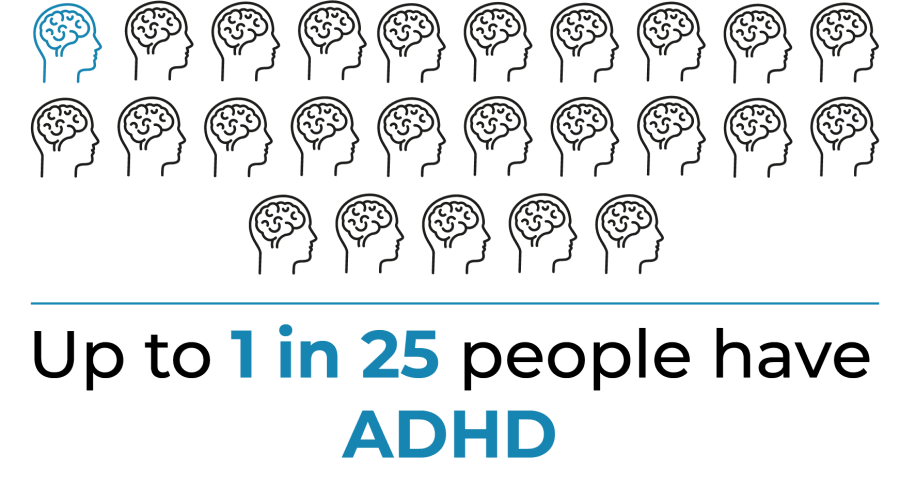
ADHD is more commonly diagnosed in boys than in girls. However, in adults the diagnosis of ADHD in men and women is more equal. This might be because, as children, boys are more likely to show hyperactive and impulsive symptoms, which are more noticeable.
When it comes to diagnosis, girls and women might be more likely to:
Below is a list of the core symptoms of ADHD. For someone to be diagnosed with ADHD, these symptoms need to cause significant difficulties in at least two areas of daily life. For example, home, education or employment, relationships and housing.
There are lots of other experiences that people with ADHD report having that might not be covered here. We have included examples that cover a broad range of ages, from young people who are still in education, to people who are in the workplace.
| Inattention | Hyperactivity and impulsivity |
|---|---|
| Lack of attention to detail | Fidgeting or tapping hands or feet, squirming in seat |
| Struggling to focus on tasks or activities | Leaving your seat in situations when remaining seated is expected |
| Struggling to listen when spoken to directly | Feeling restless and having a lot of energy |
| Not following instructions, and failing to finish work, chores or other duties | Difficulties playing or taking part in leisure activities quietly |
| Trouble organising tasks and activities | Talking excessively |
| Avoiding or disliking tasks that require mental effort over a long period of time (such as schoolwork, homework or housework) | Blurting out an answer before a question has been completed |
| Losing important things (e.g. school materials, pencils, books, tools, wallets, keys, paperwork, glasses, mobiles) | Struggling to wait your turn |
| Getting easily distracted | Interrupting or intruding on others |
| Being forgetful | |
Making mistakes at school or work, or in other activities |
Not all of these symptoms will be obvious to others. People with ADHD will often develop ways to hide their symptoms, and doing so can be very exhausting and negatively affect their mental health.
It can be helpful to think of ADHD not just as a deficit or disorder but as a ‘difference’. Some people view some aspects of their ADHD as strengths in certain situations or environments:
Some people with ADHD can use these traits to their advantage. Other people might need supportive structures to build on these strengths.
“I got fed up of being kept told I’m disruptive, I’m rude, I always interrupt. And not the fact that I was eager. I was keen. I was excited. One teacher I remember who was fantastic in my high school, she would say I love your eagerness, but just hold on for five minutes. It made me feel good.” – Hameed
Friends and family might notice signs of ADHD in someone they know. The Canadian ADHD Resource Alliance (CADDRA) has a helpful list that might indicate someone you know has unsupported ADHD:
People who have a direct relative who has ADHD are also more likely to have ADHD themselves.
“I celebrate my brain as much as I struggle with it. The balance here, for me, is important. This has taken me years, but I can recognise strengths in myself because of my neurotype. I won’t be reduced to ‘deficits’. My difference is MY experience to own.” – Clare
In recent years, ADHD services across the UK have seen an increase in the number of referrals. There are lots of possible reasons for this, including:
More people being referred for ADHD assessments is a positive thing, because it means that those who do have ADHD can receive the support they need. Those who find out that they don’t have ADHD, but have related support needs, can also get help.
Some people incorrectly say that ADHD is ‘fashionable’ or ‘made up’. In fact, the first description by a doctor of a disorder resembling ADHD was in the 18th century. The name of the disorder has changed over time but the same challenges are described that we recognise as ADHD today.
There is agreement between health care professionals and scientists around the world that ADHD is a valid diagnosis. There are clear guidelines describing how ADHD is diagnosed, and how it should be assessed, supported and treated.
ADHD can start to show itself at an early age, and is often first noticed when someone is at school. However, some people might not experience challenges until adulthood, or these challenges might not be noticed until they are much older.
Although people with ADHD share common, ‘typical’ symptoms, ADHD can look different from person to person. What ADHD looks like can depend on a person’s:
Hyperactive and impulsive symptoms tend to be more common in childhood and be less of a challenge for some people over time. Inattentive symptoms tend to become more of an issue in teenage years and adulthood.
Usually, as young people grow up, they experience more challenges and receive less support. For example, if someone has lived at home and had lots of support, their ADHD might not cause them problems until they move out of home.
Young adults with ADHD often face new challenges, such as:
Throughout life, new challenges like parenthood might further increase a person’s overall level of stress. This can mean that their ADHD causes more challenges as they get older.
As the overall level of demand and stress increases, people with ADHD are more likely to struggle to keep up. When this happens, they can become overwhelmed and unwell. This can be avoided through appropriate support. You can find out more about this in the section on support further on in this resource.
“I was told just yesterday by my GP… and she’s referred me for confirmation. I’m processing the feelings about it right now. I’m 38 – it’s been missed throughout my entire life. I could never vocalise how I felt until now.” Rachael
For most people with ADHD, the condition is caused by a combination of genetic and environmental factors.
Studies have shown that the genetic and environmental factors leading to ADHD are also found in other common mental and physical health conditions.
Research has shown that other mental and physical health conditions are more common in people with ADHD. These include:
If you think you have ADHD and it is having a negative effect on your life, speak to your GP, who will be able to refer you to the most appropriate service for you. This is often a Community Mental Health Service or a specialised Neurodevelopmental Service.
Unfortunately, we know that some people struggle to be referred for an ADHD assessment. This might be because of a lack of knowledge about adult ADHD, or because their challenges are thought to be caused by something else. For example, some people are diagnosed with a mental health problem like anxiety, depression or a substance use disorder, when this only explains part of their difficulties. When this happens, underlying ADHD can be missed.
We also know that waiting lists for assessments can be very long, which means some people have to wait a long time for a diagnosis. How long you have to wait might depend on where you live.
You might have used a questionnaire or quiz to find out whether you have ADHD. Questionnaires can help with the assessment process but ADHD can only be accurately diagnosed with:
NICE (the National Institute for Health and Care Excellence) have guidelines that apply in England and Wales for diagnosing ADHD. Regardless of where you live in England or Wales, your assessment should follow these guidelines.
A thorough assessment report would include, at least, all of the following:
In addition to NHS services there are many providers who offer ADHD assessments privately.
If you have an assessment elsewhere, specialist NHS Adult ADHD services will check that your report includes all of the detail above before accepting you into the NHS service. This is because prescribers of ADHD medication need to ensure that they have all information required to prescribe safely, and for the right condition.
For this reason, before getting an assessment from an alternative provider you should make sure that it will be accepted by your local NHS service.
After getting a diagnosis of ADHD, you might go through an adjustment period. You might experience different emotions, including:
If you have been diagnosed with ADHD, this diagnosis might become an important part of how you see yourself. It can be hard to get the balance right between:
A solution-focused approach, which looks at what is difficult in your life, and what can be done to make things less difficult, can help with this balance.
“I’m in an emotional rollercoaster at the moment. I wish it had been noticed sooner. I only considered it after listening to lived experience rather than stigmatised stereotype.” – Rachael
If you have received a diagnosis of ADHD, the person who assessed you should talk with you about:
They should also refer you to any services or information that might be helpful.
Before starting treatment, the person who assessed you should talk to you about:
Something that can make the biggest difference is being around people who understand ADHD, and being in environments that bring out the best in you. This could mean being offered reasonable adjustments at work, or an Occupational Therapist helping you to develop a successful home routine.
We explore these things in more detail below, but remember that environmental modification can be one of the most important parts of the support you get for ADHD.
It is important to remember that there isn’t one solution that will make all ADHD symptoms go away. As you read through this information, it might be helpful to think about how your symptoms effect different areas of your life.
“Whilst ADHD can be extremely difficult to manage, with help I have been able to learn about my tendency to get very absorbed in activities I love and to use this in a constructive way.” – James
Peer support groups provide free or low-cost services where people with ADHD can listen and share experiences, advice, strategies and tips. They are also an opportunity to socialise. Group meetings may be online or face-to-face. The availability and quality of peer support groups will vary, depending on where you live.
Learning more about a health condition can be useful, and a lot of information about ADHD can be found online. It is important to remember that the quality of online information varies. Unfortunately, online information can be inaccurate, misleading or even false. We have included some helpful websites at the end of this resource.
Occupational Therapists can work with people with ADHD to help them to:
The aim of occupational therapy is to help people to live as independently as possible and to participate in meaningful activities.
You might be able to get a referral for free occupational therapy from the NHS or social services. This will depend on your circumstances. You might also choose to pay for an independent occupational therapist. The Royal College of Occupational Therapists has a list of qualified and registered occupational therapists.
“If I had known that people with ADHD start a lot of things and don’t finish them… that was definitely me. And if I had known it was because of ADHD I would have been more cautious about doing things on impulse without thinking.” – Hameed
Under the Equality Act 2010, employers, colleges and universities must make ‘reasonable adjustments’ so that people with protected characteristics are not put at a substantial disadvantage. These protected characteristics include disability, which covers ADHD. You can find out more about disability and the law on the government website.
The kind of reasonable adjustments someone with ADHD will get depends upon:
Some examples of reasonable adjustments include:
The Association of Graduate Careers Advisory Service offers more examples (PDF).
Access to Work is a service provided by the Department for Work and Pensions. It can offer practical and financial support to people with disabilities. It is available to people who are employed, self-employed, or looking for employment.
It is only available to people who need support or adaptations beyond the ‘reasonable adjustments’ which employers are legally required to provide. For example, Access to Work may help pay for a job coach or providing additional training.
More information about eligibility and the application process is available on the UK Government’s website.
Some psychological therapies can help you to manage the symptoms of ADHD. These include:
You can find out more about therapies that can be helpful in ADHD on the NHS website.
When you are looking for a therapist, find out if they are knowledgeable about ADHD, or are willing to learn. This will help you to get supportive, positive care. It is also important because some of the challenges that come with ADHD could impact your therapy. For example, forgetfulness could mean that you miss or are late to an appointment, or you might struggle to work on set tasks outside of appointments.
Find a talking therapy service near you on the NHS website.
CBT is a structured programme of therapy that helps people identify unhelpful thought patterns and develop techniques for overcoming them.
If you have ADHD, CBT can help you with:
In ADHD, CBT tends to be most effective when it is combined with medication.
Coaches or mentors can help with building daily life skills such as time management, and making environmental modifications. There are coaches who specialise in helping people with ADHD.
It is important to remember, however, that coaching and mentoring are self-regulated professions without regulatory legal standards. Coaching and mentoring services vary in quality and expertise.
If you have tried environmental modifications and are still struggling, you might find medication helpful.
Before starting medication, the person treating you should check your mental and physical health. They should inform you about the risks associated with taking stimulant medications if you have any other health conditions, and should support you to monitor yourself for any side-effects. Once you are taking a medication that is working for you, it should be reviewed at least once a year.
There are several different medications available for treating ADHD. These fall into two groups:
Stimulant medications:
Stimulant medications increase the availability of the neurotransmitters Dopamine and Noradrenaline in areas of the brain that help to control attention and behaviour. There is good evidence for using stimulants to treat ADHD, and in most people they are effective, safe, and well tolerated. You will usually be able to tell quickly if they are helpful or not.
The medication needs to be built up gradually to minimise any side-effects and to find the right dose for you. Most people get noticeable benefits from the first medication they try. Other people might need to try a different medication to get the best results.
Many people wonder why simulant medications are used to treat a condition that causes hyperactivity. These medications strengthen a part of the brain that can help to control the areas of the brain that drive hyperactivity.
Non-stimulant medications:
Non-stimulant medications increase the availability of Noradrenaline or mimic its effects. They tend to take longer to start having an effect than stimulant medications. They are generally used if stimulant medications haven’t worked for you or if you find them difficult to take.
Many people with ADHD who use medication find it very helpful, but there are also people who choose not to take medication or are unable to. All medications have side effects, and some people find these more noticeable than others.
Some people will buy ADHD medications without a prescription. This might be because they suspect they have ADHD but don’t want to or can’t get an assessment. Other reasons for taking non-prescribed ADHD medications include:
Buying ADHD medication online or getting it without a prescription can be dangerous, because you:
There is no conclusive evidence that taking ADHD medication improves performance in people who don’t have ADHD.
“There are black market websites out there that sell things, but they’re not regulated and you don’t necessarily know what you’re getting, and it’s very risky.” – James
There are a number of things that people with ADHD can do to support their overall health and wellbeing.
As with any health condition, people often want to help but don’t know how, and end up giving unhelpful advice. Tell the people in your life about the things you do and don’t find helpful.
Regular exercise is good for everyone. In people with ADHD, it has been shown to significantly reduce symptoms related to anxiety and depression, which can make ADHD symptoms worse. Exercise has not been shown to have a positive impact on hyperactive, impulsive, or inattentive symptoms.
Not sleeping well can make ADHD symptoms worse. Developing good sleeping habits can be challenging, but there are some things you can try:
A large study has shown that there is a relationship between inattentive symptoms and unhealthy eating habits, including eating foods high in added sugar. An unhealthy diet negatively impacts physical health and possibly mood, which could make it more difficult to manage ADHD symptoms.
By law you must tell the Driver and Vehicle Licensing Agency (DVLA) about any condition that may affect your ability to drive safely.
If you’re not sure if your ADHD, or your ADHD medication affects your ability to drive safely, speak to your doctor. If ADHD does affect your driving and you do not tell the DVLA, you can be fined up to £1,000. If you’re involved in an accident you may be prosecuted.
You can find out more about this on the DVLA website.
If you know someone who has ADHD, there are a number of things you can do to make life easier for them, and yourself.
Just because you’ve met one person with ADHD doesn’t mean you’ve met them all. Finding out more about the condition can help you to get a stronger understanding of ADHD. It will also show the person that you care about them.
“It’s exhausting, variable and infuriating multiple times a day. It can impact every aspect of your life and a lot of that is hidden, especially with the mental load of women juggling home, work, family. People have no idea.” – Margaret
Some adult ADHD peer support groups run separate groups for partners and spouses, or allow them to participate in the ADHD groups. Check with the group first before attending. You will usually be able to find out more about a peer support group online.
Ask the person you know if there is anything you can do to help. If they can’t think of anything right now, you can let them know you are there if they need someone to talk with in the future.
There are a lot of misconceptions about ADHD and the people who have it. You can help by informing yourself and other people about the realities of ADHD.
If you find the behaviour of the person you know upsetting or frustrating, talk through your feelings with someone you trust. If there are problems you want to bring up, try to explain clearly what the issue is and what you think could help. There may be things that both of you can do to help solve the issue.
“Sometimes when we talk about disability, we make assumptions that it’s got to be something visible. And when you have ADHD it’s not so visible, and people just put it down to your personality.” – Hameed
Data provided courtesy of Royal College of Psychiatrists, www.rcpsych.ac.uk
These guidelines cover recognising, diagnosing and managing ADHD in children, young people and adults. They aim to improve recognition and diagnosis, as well as the quality of care and support for people with ADHD.
Below we have included details of some charities that work with and for people with ADHD:
This information was produced by the Royal College of Psychiatrists’ Public Engagement Editorial Board (PEEB). It reflects the best available evidence at the time of writing.
Expert authors: Dr Dietmar Hank and Dr Kate Franklin
Thank you to the people with lived experience of ADHD who helped to develop this resource, and kindly agreed to share their experiences as quotes:
Clare Dudeney, Hameed Khan, James Downs, Margaret Reed Roberts and Rachael Taylor.
Special thanks to Susan Dunn Morua, founder and facilitator of the Bristol Adult ADHD Support group.
Full references available on request.
Share this page by scanning the QR code with your phone’s camera: